AI and Me
Artificial intelligence provokes mixed feelings within me, like I imagine it does for most people. I know firsthand how powerful and helpful it can be to creators such as myself. I write longhand, and all I need to do is take a photo of each page, send it to Gemini, and voila! My manuscript is transcribed into a Google Doc in no time flat. When it comes to researching and fact-checking, I feel like I’m using Google on steroids. I can cover a lot more ground in a lot less time, and the model gives me links so that I can double-check its work, if I need to. Proper grammar is the bane of my existence, and Gemini has helped me spot more comma splices, missing words, and dangling participles than I can count. For example, in that previous sentence, I had originally written, “if need to.” I read it out loud several times, adding the word “I” unconsciously. Gemini caught it, however. AI has absolutely saved me a lot of time and has made my writing better than it would have otherwise been.
But there are aspects to AI that are disheartening. It can feel like there's no point in putting months of my life into writing a book when, according to Claude, AI agents could have a polished 50,000-word manuscript in an hour or less. For comparison, it takes me about an hour to write a 1,000-word first draft of a blog post. It takes at least another hour, or maybe two, to completely edit it and get it to final draft condition. Novels are a different animal altogether. Checking for continuity errors, word/phrase repetition, and general pacing and flow adds weeks and months to the timeline.
I love to write. I can’t give it up, even if the machines are faster. Every creative has to figure out their boundaries with AI, and I’m muddling through the best I can. I will not use AI to brainstorm or “co-create” my story. If I’m stuck on a plot point or a character name (they take me forever!), I just keep chipping away at it until I’m not stuck anymore. To me, that falls under my job as the writer. On the other hand, I don’t mind using AI to proofread and catch grammar and spelling errors.
One place where I’m a waffler is AI art generation for book covers. The first book I ever wrote, way back in the day, was Baby Potty Training: Potty Train Your Baby From Day 1. My husband, J, and I used a premade template from CreateSpace and added our own text and photographs. Later on, we switched to making text-based covers from scratch. But when it came time to do my first fiction book covers, I knew the marketplace expected image-based ones. The first cover I did for Escape From Olshek’s Castle was sort of a collaboration. I found a Creative Commons-licensed photo on Pixabay, edited it in Photoshop, added some text, and had my cover.
Then Midjourney came onto the scene. I played with it a bit and realized my covers could look a whole lot better if I used it. The way I looked at it, at the time, was that it was really no different than using one of those premade templates from CreateSpace. I promptly used AI to redo all my weight loss book covers, and then used it for my young adult fantasy fiction books.
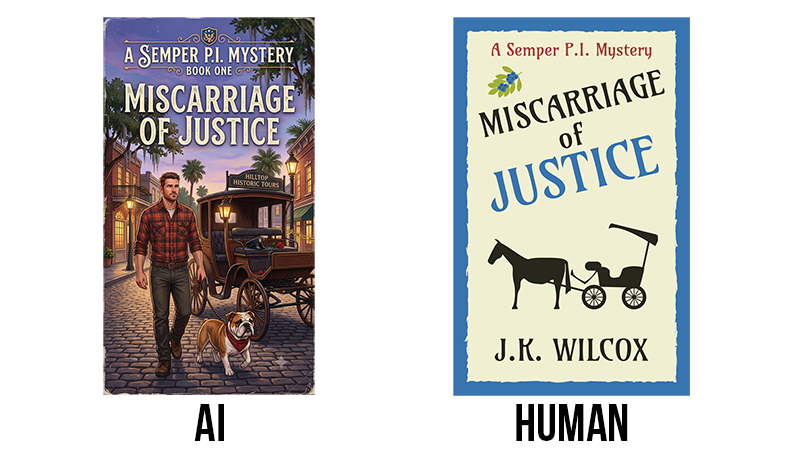
But it has continued to bug me that I used AI, mainly because I love to draw. I drew the cover for Overcoming Weight Loss Obstacles, and I was very pleased with it. The problem is, it took me a coon’s age to actually finish it. A few months ago, J used Gemini to quickly generate some cover art for our first cozy mystery in the Semper P.I. series, Miscarriage of Justice. But I decided that for the actual book release, I wanted to create our own cover art from scratch. It took me a few days, but I created something I'm much more pleased with than the AI-generated cover we initially had.
Here's the side-by-side comparison. We are finishing up those final edits and hope to have the book out soon.
If you’d like to be notified when our books get published, sign up for my newsletter here.